
Skyrocketing Tungsten Carbide Prices: Industrial Changes and Market Games Amid M
Skyrocketing Tungsten Carbide Prices: Industrial Changes and Market Games Amid Multiple Resonances
Price Status: From Stability to Irrational Surge
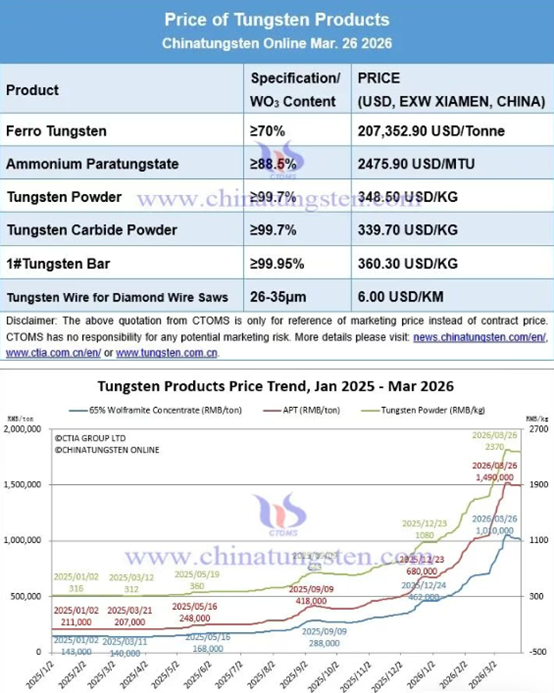
Root Cause of the Surge: Supply-Demand Imbalance Driven by Multiple Factors
Core Alternative Paths: Three Product Categories Reshaping the Industry
1. Superhard Composite Material Substitution: PCD Saw Blades Become the "Hard Currency" for High-End Scenarios
Core Advantages: Although the upfront purchase cost is 4–5 times that of traditional cemented carbide saw blades, their service life is extended by more than 10 times, greatly reducing tool changes and downtime. They produce burr-free cuts with high precision and significantly improved workpiece surface finish, cutting down post-processing steps.
Applications: Widely used in woodworking (man-made boards, veneered panels, laminate flooring), aluminum profile cutting, photovoltaic wafer slicing, stone precision cutting and more.
Market Value: With growing demand for high-end manufacturing, PCD saw blades continue to gain penetration and become standard equipment for medium-to-high-end cutting, effectively easing performance and cost pressures from rising tungsten carbide prices.
2. New Material Substitution: Ultra-Thin Cutting Blades and Cermets for Cost Reduction and Efficiency Improvement
- Ultra-Thin Cutting Blades: 1.0 mm thick, 54-tooth ultra-thin blades made of special steel or lightweight alloys are over 50% thinner than conventional saw blades, achieving triple cost savings:
Reduced material loss: Narrower kerfs cut workpiece material waste by over 90%.
Lower energy consumption: Cutting resistance reduced by 25% and energy use lowered by 18%.
Higher efficiency: Lighter weight enables higher equipment speeds, boosting productivity by 12%.
Ideal for thin sheet and precision parts cutting.
- Cold Saw Blades: Using ceramic tips as a reinforcing phase to replace part of the tungsten carbide content, they offer hardness and wear resistance close to traditional cemented carbide. Ceramics also provide superior heat resistance, cutting temperatures by 60% and preventing workpiece burning, suitable for low-to-mid range cutting and non-ferrous metal processing.
- Dry-Cut Saws: Driven by a motor to rotate at high speed, the teeth cut materials while heat dissipation and chip removal rely on blade structure and airflow. No water or coolant is required throughout the process, enabling fully dry cutting.