
Differences Between Cold Saw, Flying Saw and HSS Saw Blades | Metal Cutting Saw
In the metal processing and manufacturing industry involving steel pipes, profiles, stainless steel and other metal materials, saw blades are core consumables that determine cutting finish, production efficiency and production costs. Many processing enterprises and procurement personnel often struggle with selection issues: What are the differences between a cold saw and a flying saw? What materials are HSS saw blades suitable for? How to select the appropriate metal circular saw blade for different production lines and materials?
The core logic is straightforward: HSS (High-Speed Steel) is the manufacturing material of saw blades, while cold saw and flying saw refer to two different metal cutting processes and equipment. Though they belong to different dimensions, their matching performance directly decides the final cutting results.
This article comprehensively analyzes their differences from working principles, material properties, core advantages and application scenarios, helping enterprises achieve accurate selection, cost reduction and efficiency improvement.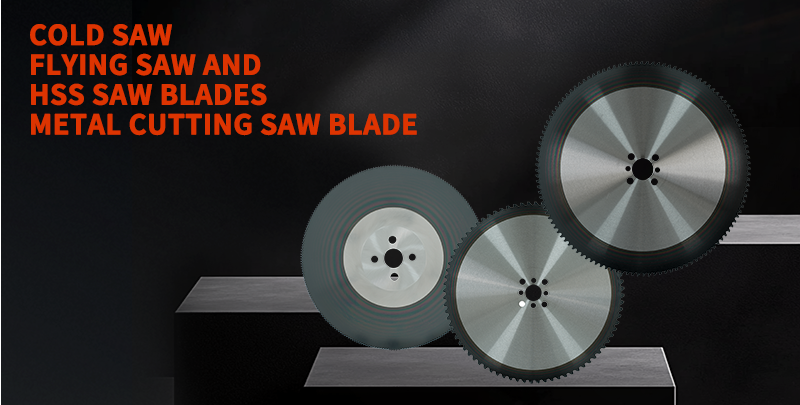
1. HSS Saw Blade: Core Material for Mainstream Metal Cutting Saw Blades
An HSS (High-Speed Steel) saw blade is a metal circular saw blade made of high-speed steel substrate. As a mainstream blade for precision and mass metal cutting, it features high hardness, excellent toughness, wear resistance and heat resistance. It is applicable to the cutting of carbon steel, alloy steel, stainless steel, copper and aluminum profiles, and compatible with cold saws, flying saws and various other cutting equipment.
Common HSS saw blades are divided into two main series for different working conditions:
1.1 M2 HSS Saw Blade (Cost-Effective Universal Type)
M2 high-speed steel is a universal basic material in the industry with balanced comprehensive performance. Its moderate toughness and wear resistance meet the cutting requirements of conventional metals without redundant performance, delivering extremely high cost performance.
Applicable Materials: Ordinary carbon steel, low alloy steel, common welded pipes, profiles, round pipes, square pipes and other conventional metal materials
Core Features: Wide application range, stable cutting performance, low tooth breakage rate and balanced service life, suitable for medium and low-intensity daily processing scenarios
1.2 M35/M42 Cobalt-Bearing HSS Saw Blade (High-Strength Wear-Resistant Type)
Cobalt elements are added to conventional high-speed steel to significantly improve the material’s hardness, heat resistance and high-temperature wear resistance. It can withstand high-speed, high-temperature and high-intensity continuous cutting, serving as a special saw blade for difficult-to-process metals.
Applicable Materials: Stainless steel, high-strength alloy steel, thick-walled pipes and other high-hardness difficult-to-process metals
Core Features: High temperature resistance, impact resistance and double wear resistance. It effectively avoids blade edge softening and rapid wear under high temperature, supports 24-hour continuous mass production, and boasts a far longer service life than ordinary M2 saw blades.
2. Cold Saw: High-Precision and Low-Deformation Static Cutting Process
A cold saw is cutting equipment and process adopting low cutting speed and high torque output. It generates minimal heat during cutting, and the professional cooling and lubrication system quickly dissipates cutting heat, keeping both workpieces and saw blades at a low temperature — hence the name "cold saw".
Cold saw equipment can be equipped with HSS saw blades and carbide saw blades, featuring high precision, burr-free cutting and low deformation. It is the preferred process for precision metal processing.
Core Advantages of HSS Saw Blades for Cold Saws
1. High cutting precision and superior finished product quality
Cold saws operate stably with uniform cutting speed and no severe vibration. The cut workpieces feature smooth and flat notches without curling edges and burrs, and minimal material deformation. No secondary grinding is required, which greatly improves the qualified rate of finished products.
2. Low blade loss and stable service life
The low-temperature cutting environment fundamentally prevents blade edge softening, tooth burning, rapid wear and tooth breakage. Combined with optimized tooth design, the saw blade durability is significantly improved, ensuring stable processing and reducing losses caused by frequent blade replacement and equipment debugging.
Core Application Scenarios of Cold Saws
It is widely used in high-precision processing fields, including precision steel pipes, stainless steel decorative pipes, auto parts, precision copper and aluminum profiles, high-end hardware accessories and other products with strict requirements on notch flatness and dimensional accuracy.
3. Flying Saw: High-Speed and Non-Stop Dynamic Cutting Process
A flying saw is a special cutting process adapted to fully automatic high-speed production lines. The biggest difference from cold saws is: cold saws perform fixed-point cutting on static workpieces, while flying saws complete synchronous follow-up cutting on moving workpieces.
Flying saws realize on-line fixed-length cutting without equipment shutdown, specially serving large-scale and high-speed pipe mass production lines.
Core Advantages of HSS Saw Blades for Flying Saws
1. Adaptable to high-speed continuous mass production with strong impact resistance
Flying saws are mainly applied to high-frequency welded pipe, straight seam welded pipe and square/rectangular pipe production lines with fast production speed and high cutting frequency, which impose high requirements on the impact resistance, wear resistance and stability of saw blades. Special HSS flying saw blades can withstand high-frequency continuous cutting without tooth breakage and excessive wear, perfectly adapting to high-intensity mass production conditions.
2. Non-stop operation to maximize production capacity
The biggest advantage of flying saws is on-line synchronous cutting, which eliminates shutdown for feeding and fixed-point waiting. It significantly improves the automation level of production lines, shortens production cycles and boosts overall production capacity, making it ideal for mass production of standardized pipes.
4. Core Summary: Selection Logic for Cold Saws, Flying Saws and HSS Saw Blades
The core positioning of the three types can be clearly distinguished for quick selection:
HSS Saw Blade: It is the material carrier of cutting tools, divided into M2 universal type and M35/M42 cobalt-bearing wear-resistant type. It is compatible with most metal cutting scenarios and applicable to both cold saw and flying saw equipment;
Cold Saw Process: Focuses on high precision and high quality. It delivers perfect notches and low deformation & loss, suitable for precision and high-end product processing with moderate efficiency and optimal finished product quality;
Flying Saw Process: Focuses on high speed and high productivity. It supports non-stop mass production and efficient output, suitable for large-scale standardized pipeline production with high efficiency.
5. Industry Selection Recommendations
Saw blade selection directly affects production efficiency, finished product quality and production cost. Improper selection will cause problems such as tooth breakage, burrs on notches, workpiece deformation, rapid blade wear and frequent shutdown for blade replacement, greatly increasing operating costs.
Donglai Metal has been focusing on the manufacturing of high-performance metal circular saw blades for years. We specialize in the R&D and production of HSS saw blades dedicated to cold saws and flying saws. We provide customized saw blade solutions for different metal materials (carbon steel, stainless steel, alloy pipes, copper & aluminum profiles) and production line working conditions, balancing cutting precision, production efficiency and service life to help enterprises reduce costs, improve efficiency and achieve stable mass production.